

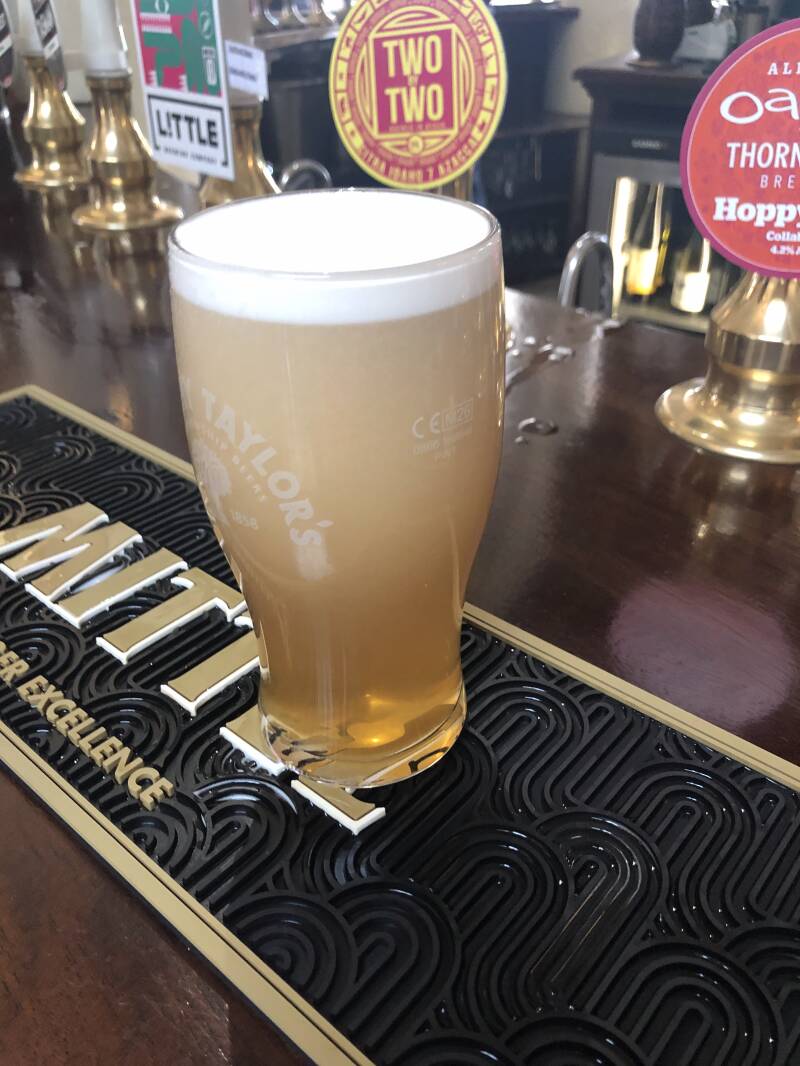
A short one this time... although, as with most beer-related discussions, it might end up being longer than intended.
Few topics in the beer world generate quite as much debate as the question: What is craft beer?
For some, it's an important distinction. For others, beer is beer, and all this craft-versus-not-craft business can be viewed as just beer snobbery.
The reason I'm writing about it stems from a recent conversation in my home-from-home, the excellent pub/B&B where I spend my evenings when travelling for work.
The pub has three rotating cask ales on the bar, all of which are kept exceptionally well. If you've read my previous blogs, you'll know that good cellar management can elevate even an ordinary beer, and these are consistently excellent.
Alongside the cask selection sat the usual collection of kegged offerings, including Beavertown. The locals largely ignored it. At over £7 a pint, it was around £2 more expensive than most of the other beers available, and in a traditional pub that's often enough to make customers think twice. Especially in the North of England....
A week or two ago, I arrived to find the staff positively buzzing with excitement.
"We've got a new craft beer line-up!"
Apparently, they were particularly excited for me to see it because, in their words, I was "one of those craft beer aficionados."
I should probably point out at this stage that "aficionado" is a much nicer description than some might use. For instance, 'nerd' or 'bore' is possibly more accurate.
Anyway, I wandered over to investigate.
The newly installed taps featured Camden Pale Ale, Camden Easy IPA, and a fresh line of Modelo, which I was informed was an excellent Mexican lager.
The staff stood expectantly, waiting for my reaction.
The trouble was, I knew the story behind Camden.
Years ago, Camden Town Brewery was one of the UK's genuine craft brewing success stories. Then in 2015 it was acquired by AB InBev, the world's largest brewing conglomerate. Overnight, depending on who you ask, it became either a successful brewery with greater distribution or another victim of the dark side. My view is firmly the latter.
I politely explained that Camden was one of the breweries I'd personally removed from my "craft beer" list after the takeover.
The response was immediate.
"We thought at least you'd like it..."
The disappointment was palpable.
Because I genuinely like the team there, and because I had just come back from a run in nearly 30°C heat, I reluctantly ordered a pint.
The best thing I can say about it was that it was cold.
I, meanwhile, was very hot and I was still sweating from the run despite a cold shower.
Sadly, that was about where the praise ended. Compared to the original Camden Pale I remembered from years ago, this version seemed largely devoid of character. Perfectly drinkable. Entirely inoffensive. But also completely forgettable.
Which brings me back to the question.
What is craft beer?
Because the funny thing is that the pub team genuinely believed they'd just entered the craft beer world.
Yet I'd argue they'd been serving craft beer all along.
Those beautifully kept cask ales on the hand pulls? Many were brewed by small independent breweries, using traditional methods, quality ingredients and enormous amounts of care.
If that's not craft, what is?
The Official Definitions
Defining craft beer is surprisingly difficult because there is no universally accepted definition. It's as much a philosophy as it is a category.
A commonly used definition is:
Craft beer is beer produced by independent brewers who focus on quality, flavour, traditional brewing methods and innovation rather than mass production.
That sounds reasonable enough.
The Americans, never ones to shy away from defining things, went a step further.
The Brewers Association traditionally described a craft brewer as being:
- Small: Producing relatively limited quantities compared with major breweries.
- Independent: Less than 25% owned or controlled by a large alcohol company.
- Traditional: Producing beers whose flavours derive from traditional or innovative brewing ingredients and processes.
It's a useful framework.
But personally, I've never entirely agreed with it.
Why?
Because it focuses heavily on ownership, scale and process whilst missing what I believe is the most important aspect: intent.
The British Perspective
In the UK, the definition tends to be far more relaxed.
Most people would probably describe craft beer as beer that is:
- Produced by an independent brewery.
- Focused on flavour and quality.
- Made with premium ingredients.
- Brewed on a smaller scale.
- Sometimes experimental or innovative.
Under that definition, craft beer could be:
- A hazy New England IPA bursting with tropical hops.
- A barrel-aged imperial stout.
- A Belgian-style saison.
- A traditional cask-conditioned bitter from a village brewery.
That's where I think some people get confused.
Craft beer doesn't have to be cloudy.
It doesn't have to be served in a fancy glass.
It doesn't have to be £8 a pint.
And it definitely doesn't have to contain enough hops to strip paint.
What Craft Beer Is Not
In my opinion, craft beer is not simply:
- Beer brewed by hand.
- Home-brewed beer.
- Expensive beer.
- Hoppy beer.
- Unfiltered beer.
- Beer served from a keg rather than a cask.
A carefully brewed traditional bitter from a tiny independent brewery can be every bit as "craft" as the latest triple-dry-hopped, lactose-infused, mango-and-passionfruit IPA with a label designed by someone who clearly enjoys psychedelic art.
Possibly more so.
The Spirit of Craft Beer
If I had to define craft beer in a single word, it would be this: Passion.
Craft brewers obsess about ingredients. They debate yeast strains. They argue over hop schedules. They venture willingly down the rabbit hole of water chemistry. They experiment with fermentation temperatures. They spend countless hours chasing tiny flavour improvements that most drinkers may never consciously notice.
And then they do it all again.
Why?
Because they're trying to create the best beer they can, not simply the cheapest beer they can. To me, that's the essence of craft brewing.
My Definition
I'd define craft beer like this:
Craft beer is more than a beverage; it is an approach to brewing. While large commercial breweries focus on consistency and scale, craft brewers prioritise flavour, creativity and quality. Whether it is a traditional cask-conditioned bitter or a modern hop-forward IPA, craft beer reflects the brewer's passion, personality and desire to create something distinctive rather than simply producing another pint of beer.
Or, if you prefer the shorter version:
Craft beer is beer made by people who spend an inordinate amount of time arguing about malt varieties, hop schedules, yeast strains and water chemistry, all in pursuit of a slightly better pint.
And frankly, that sounds like exactly the sort of people I'd happily share a beer with...
Create Your Own Website With Webador